

Source : China Chemical Industry News
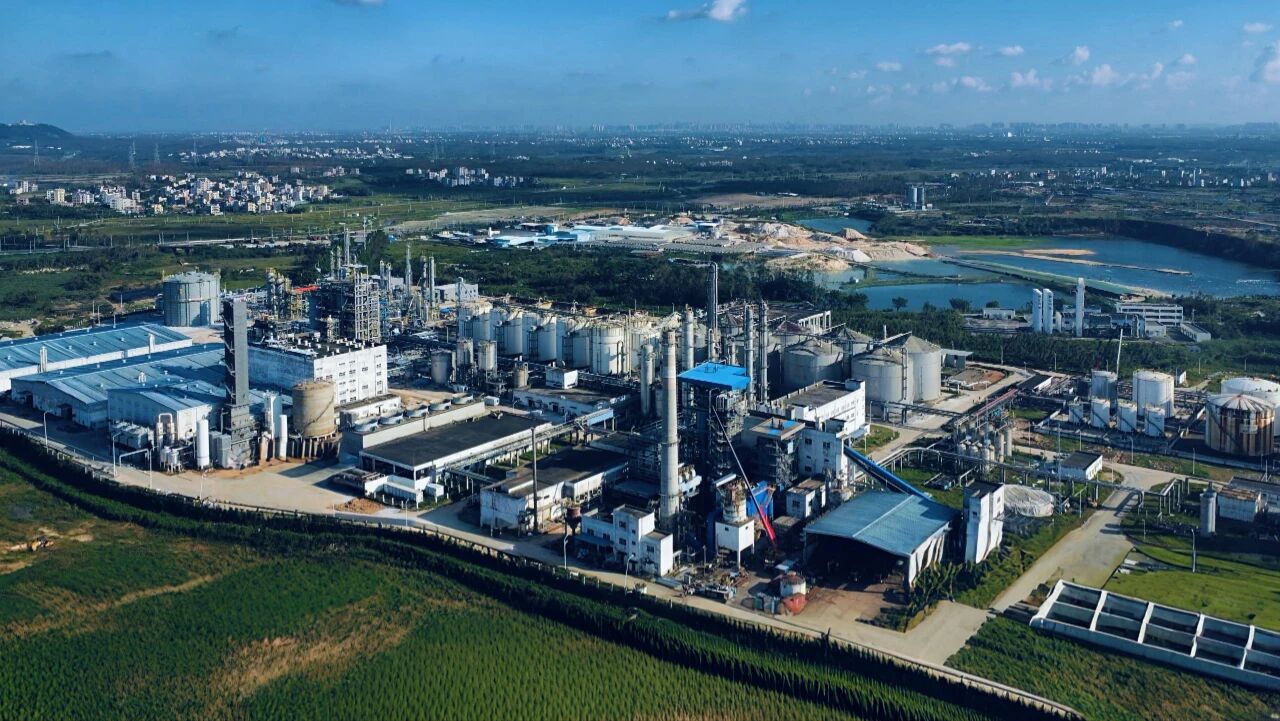
China’s first large-scale biomethanol project—the CIMC Enric Green Energy 50,000 t/y biomass gasification–to–green methanol demonstration project—was officially commissioned on December 16 in Zhanjiang, Guangdong Province. The first batch of green methanol products has already been bunkered to an international ocean-going vessel at Shenzhen Port, providing key technological support for the low-carbon transition of China’s shipping industry.
This demonstration project is the world’s first to adopt a biomass gasification–Fischer–Tropsch synthesis coupled with biomass direct-fired power generation route. It converts biomass wastes such as tree bark and agricultural residues into green methanol with a purity of up to 99.9%, which can be used as marine fuel as well as in pharmaceutical and chemical applications. Compared with the biomass coupled with wind and solar green power methanol production route, this technology can reduce production costs by approximately 30%, offering significant economic advantages. Experts note that biomass, as a zero-carbon energy source and the sole carbon-containing feedstock, represents an important and viable pathway for shipping decarbonization through the production of green liquid fuels via “gasification–synthesis” processes.
The core gasification island of the demonstration project adopts circulating fluidized bed biomass gasification technology independently developed by the Institute of Engineering Thermophysics of the Chinese Academy of Sciences, and was jointly implemented with CAS Hefei Coal Gasification Technology Co., Ltd (ZHGAS). In this system, biomass waste is gasified and converted into carbon monoxide and hydrogen required for methanol production, while the remaining residues can be utilized as raw materials for industries such as cement manufacturing, thereby enabling resource recycling and circular utilization.
This technology addresses three major industry challenges: instability of systems caused by large variations in the physical properties of biomass feedstocks; low ash fusion temperatures and high tar by-products that can easily lead to system shutdowns; and equipment corrosion induced by alkali metals. By overcoming these challenges, it breaks through the critical “bottleneck” at the upstream end of the industrial chain. The research team innovatively proposed a “phase-separated asynchronous conversion” approach, which couples “mild gasification” with “semi-char autocatalytic cracking.” This method avoids coking while enabling in-situ, selective cracking of tars, thereby reducing tar formation at the source and increasing syngas yield. The technology also successfully resolves key issues related to uniform fluidization of multi-component particles with widely differing properties, as well as the prevention and control of alkali metal deposition and corrosion. As a result, it clears major obstacles to the efficient, stable, and long-term production of biomass-derived syngas, opening up the critical pathway for the production of high-value green fuels.
Green methanol is currently the alternative fuel with the greatest potential for carbon reduction and the strongest economic viability in the shipping industry. Compared with conventional fossil fuels, it can reduce lifecycle carbon emissions by more than 85%. This project has successfully established the critical technological pathway from waste biomass to high-value green liquid fuels. It not only provides a practical solution for China’s shipping industry to fulfill its emissions reduction commitments, but also contributes important “Chinese wisdom” and a “Chinese pathway” toward achieving the global goal of net-zero emissions by 2050.
At present, the project has established South China’s first complete green methanol “production–storage–transportation–utilization” supply chain ecosystem. Large-scale storage tanks and dedicated berths have been deployed at Zhanjiang Port, enabling a one-hour closed-loop integration of production, storage, and transportation. In addition, a same-day delivery bunkering network for vessels across the Guangdong–Hong Kong–Macao Greater Bay Area has been put in place, making it the closest green methanol supply point in China for international ports such as Singapore and significantly reducing the carbon footprint associated with transportation.